DC9 logo

AI is already at work.

Colleagues collaborating around a table during a working session

The new blind spot.

Your people have adopted AI.
Can your security controls see it?

Your teams are using public AI tools, embedded copilots and automated agents, often without approval or security oversight. DC9 shows you what's actually in use, where the risks sit, and what to do about them.

Hidden use

Unsanctioned AI tools may already be operating across your business.

Data exposure

Customer records, contracts or intellectual property may be entering public services.

Uncontrolled access

AI applications and agents may hold excessive access to business systems.

No audit trail

You may not know who used which service, what was shared or where it went.

See the AI already in play.

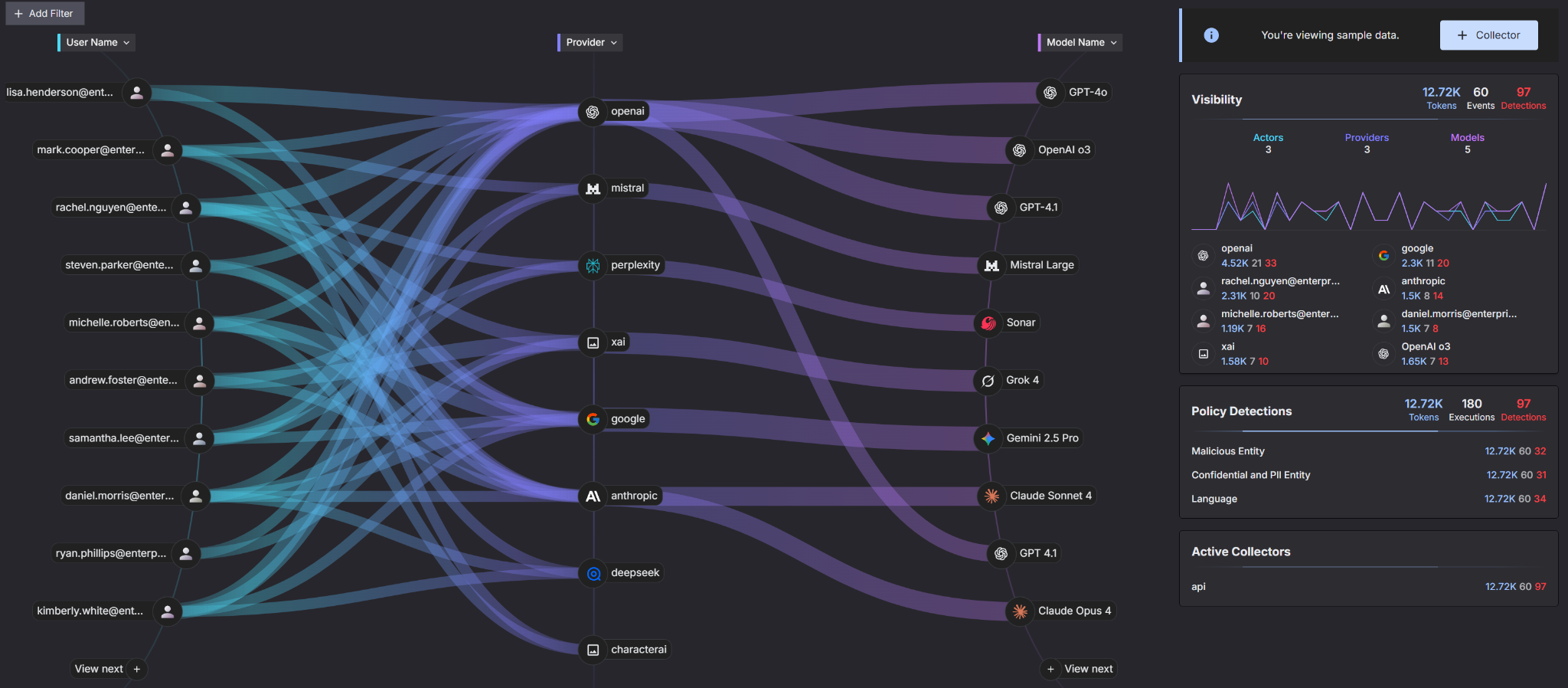
DC9 uses enterprise security technology to identify AI applications and activity across your workplace. We separate approved services from shadow AI and highlight activity that needs investigation.

  • AI applications detected
  • Users and devices identified
  • Approved and unapproved use distinguished
  • Emerging exposure prioritised
CrowdStrike AI visibility sample showing users, providers, models and policy detections

AI security doesn’t stop at the chatbot.

AI now operates across endpoints, SaaS applications, cloud services, agents and connected tools. Security has to follow the information and actions across that whole environment.

A person using a laptop in a working environment
AI now moves through the same people, devices and applications that run the business.

Endpoint

Where employees use AI tools and agents can interact with local files, browsers, credentials and applications.

SaaS applications

Where embedded assistants access corporate email, documents, CRM platforms and other business information.

Cloud, agents & MCP

Where models, agents and connected tools can access systems and act on the business.

→ The control point is the environment around AI, not only the application someone happens to open.

AI introduces a different class of threat.

Traditional security remains essential, but it was not designed to inspect prompts, validate agent tool calls or control how sensitive information is shared with AI models.

Hidden or direct instructions manipulate an AI system into ignoring its intended rules.
A malicious instruction can make an AI reveal protected information, bypass safeguards or perform an unsafe action. It may be typed directly or concealed inside a document, website, email, image, retrieved record or tool output.
Why it matters
Sensitive information is disclosed or an AI agent takes an action the organisation did not intend.
How it is controlled
Inspect prompts and retrieved content, restrict what the AI can access, and require approval for high-risk actions.

AI interactions can contain harmful links, domains, code and other indicators of compromise.
A prompt, uploaded document or AI response may include malicious URLs, IP addresses, files, scripts or code. If a person or agent follows those instructions, the AI workflow can become a path into the organisation.
Why it matters
Users, applications or autonomous agents may act on malicious content before traditional controls identify it.
How it is controlled
Inspect prompts and responses for known and suspicious indicators, then block or isolate unsafe content.

Connected AI agents can reach business systems, use tools and take actions with real-world consequences.
Model Context Protocol (MCP) lets AI connect to external tools and data. A compromised, untrusted or poorly controlled MCP server can expose information, invoke unauthorised tools or influence an agent’s behaviour.
Why it matters
An agent may read files, send information, execute commands or modify systems beyond its intended role.
How it is controlled
Discover MCP connections, validate servers, restrict tool permissions and maintain an audit trail of agent actions.

Staff can disclose confidential information simply by pasting, uploading or connecting it to an AI service.
Customer records, contracts, financial information, source code, passwords and internal documents may be submitted to public or unapproved AI services. Depending on the service, account and configuration, that information may be retained, reviewed, used to improve models or processed outside the approved environment.
Why it matters
The organisation can lose control of confidential, regulated or commercially sensitive information.
How it is controlled
Identify sensitive content and block, redact or securely route it before it reaches an unapproved model.

AI agents may inherit broad access from a user or service account.
An agent can potentially read files, access SaaS applications, call APIs, execute commands and move data without separate approval for each action. The risk increases when one identity provides access to several connected systems.
Why it matters
A mistake or malicious instruction can quickly affect multiple applications and large volumes of information.
How it is controlled
Apply least privilege, separate agent identities, limit permitted actions and require human approval at critical points.
Abstract blue and yellow gradient

What you’re not seeing

Hidden useData exposureUncontrolled accessNo audit trail

Confidential

Customer export

1,284 records
Name · email · mobile
Order history · account notes

AI assistant upload

Visibility unknown

Source / CRM export
Destination / Public service
Control status / Unknown

What could be leaving your business right now?

AI creates new paths for information to leave the business, often without the user realising it.

Customer data

Entered into a public AI assistant.

Contracts

Uploaded for summarisation.

Source code

Shared with an unapproved coding assistant.

Business plans

Used to generate analysis or recommendations.

AI agents

Given access to systems, data and actions.

Regain visibility without slowing innovation.

Practical boundaries help people use AI while keeping information, access and accountability in view.

Visible.

Know where AI is being used across applications, services and agents.

Governed.

Set clear boundaries around people, information, applications and systems.

Protected.

Keep sensitive information where it belongs.

Enabled.

Give the business useful AI capability without unnecessary risk or friction.

Innovation shouldn’t come at the expense of control. We make sure it doesn’t.

Traditional security wasn’t designed to inspect prompts, validate agent tool calls or control what sensitive data reaches a model. We close that gap, so innovation and control move together.

AI Exposure
Assessment

Understand where AI is already being used, what information it can access and where existing controls may have gaps.

Access your AI exposure

AI application and usage discovery 01

Shadow AI visibility 02

Data and identity exposure review 03

Policy and control assessment 04

Prioritised risk register 05

Practical remediation roadmap 06

Executive findings presentation 07

Discover how we can support your business, today and tomorrow

Australia - Sydney
Level 35 Tower One Barangaroo International Towers
100 Barangaroo Ave Sydney NSW 2000

Australia - Melbourne

Level 40, 140 William Street
Melbourne, VIC 3000

United States
2055 Limestone Rd Ste 200C
Wilmington, DE 19808

Philippines
Level 36, Cyberscape Gamma, Topaz Road
Ortigas Center, Pasig City, Metro Manila, 1605